AequilibraE Graphs#
A Network stores source link attributes, modes, centroids, and turn restrictions.
Its build_graph() method returns an array-backed Graph for routing.
The graph has fixed topology. Its costs can change without a rebuild.
Graphs from a model#
A project network can supply the source tables:
>>> project = create_example(project_path, "coquimbo")
>>> network = project.road.build_network()
>>> graph = network.build_graph('c', cost='distance')
The source tables do not retain project connections. Later changes to project data do not change this network or its prepared graphs.
To restrict the source data to an area, supply a polygon:
>>> from shapely.geometry import Polygon

>>> polygon = Polygon([(-71.35, -29.95), (-71.35, -29.90), (-71.30, -29.90), (-71.30, -29.95), (-71.35, -29.95)])
>>> network = project.road.build_network(limit_to_area=polygon)
The area filter uses a spatial index. It does not clip links to the polygon boundary.
Source links and directed costs#
The network.links DataFrame contains one row per physical link.
The direction field specifies the allowed directions:
1permits AB traversal.-1permits BA traversal.0permits both directions.
Direction-specific fields use the suffixes _ab and _ba. For example,
free_flow_time_ab and free_flow_time_ba supply the graph field
free_flow_time. Network preserves column names, and field names are
case-sensitive. For each direction, a suffixed column takes precedence over
the base column.
network.field_values(name) returns numeric values in physical-link input row order,
with AB before BA for each bidirectional link.
network.link_ids and network.directions use the same order.
This order includes links that the graph’s mode cannot use.
Cost updates and link closures#
To close links without a topology change, set their costs to positive infinity:
>>> import numpy as np

>>> costs = network.field_values('distance').copy()
>>> costs[np.isin(network.link_ids, [123, 975])] = np.inf
>>> graph.set_costs(costs)
set_costs() requires one value per directed network link, not one value per graph link.
A later call with finite costs can reopen the links.
Negative costs and NaN values are invalid.
For changes to numeric link attributes, edit the source data and build a new graph:
>>> network.links.loc[network.links.link_type == 'motorway', 'speed_ab'] = 100
>>> network.links.loc[network.links.link_type == 'motorway', 'speed_ba'] = 100
>>> graph = network.build_graph('c', cost='distance')
Changes to source attributes do not update an existing graph or calculate
dependent attributes. For example, a speed change does not automatically
change travel time. For topology changes (link IDs, endpoints, directions,
added/removed links or row order), construct a new Network from the revised
link table so its mappings are rebuilt. Network configuration fields are
fixed, use dataclasses.replace() to create a validated replacement when
changing modes, centroids or turn restrictions.
Skimming and centroids#
Skim fields, centroids, and centroid-flow blocking are graph construction options:
>>> graph = network.build_graph(
...     'c', cost='distance',
...     centroids=network.centroids[:5],
...     skimming=['distance'], block_centroid_flows=False,
... )
>>> skimmer = graph.compute_skims()
Without an explicit centroid array, the graph uses network.centroids.
Centroids must be unique, positive node IDs from the network.
Their order determines the row and column order of skim matrices.
To change centroids or skim fields, build a new graph.
Compact graphs#
A compact graph contracts chains of links. Dead-end removal is an additional,
separate option. These reductions can reduce routing work for traffic
assignment and centroid-to-centroid skimming. Both are opt-in when building a
graph, and both require centroids. PathResults.path contains local
graph-link indices, and get_network_links() expands these to physical link
IDs and directions in traversal order.
To enable both reductions:
>>> compact = network.build_graph('c', cost='distance', compact=True, remove_dead_ends=True)
Traffic assignment enables both reductions by default. Each TrafficClass can override
compact and remove_dead_ends through its graph_options.
Congestion calculations still use individual directed network links.
Blocking centroid flows#
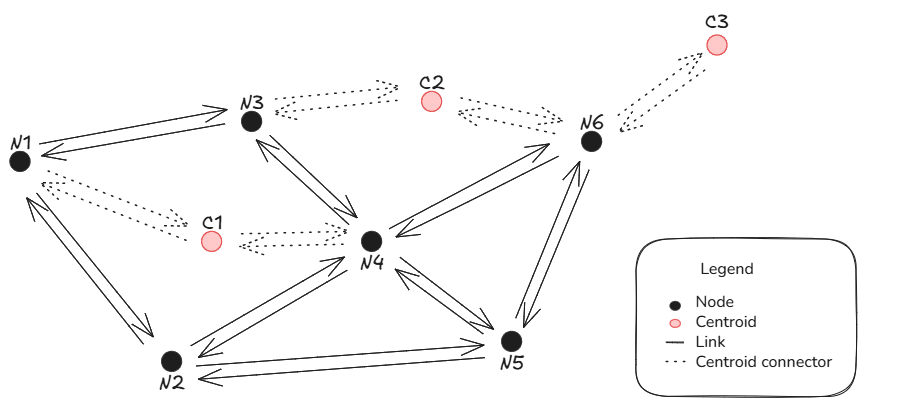
By default, prepared graphs block paths through intermediate centroids. For turn-based routing, automatic turn prohibitions prevent traversal between centroid connectors at the same centroid.
Suppose a path from N1 to C3 follows N1 -> N3 -> C2 -> N6 -> C3 in the figure. Centroid-flow blocking prohibits the connector-to-connector transition at C2. The path must use another route.
If regular network nodes serve as centroids, consider whether routes must pass through those nodes.
Use block_centroid_flows=False to permit those routes.